
Industry Overview
The packaging industry plays a critical role in the global supply chain by protecting, transporting, identifying, and presenting products throughout their journey from manufacturer to end customer. Packaging solutions extend far beyond boxes and cartons. The industry encompasses packaging materials, protective packaging, load securing systems, coding and marking technologies, packaging equipment, and related services that ensure products arrive safely and efficiently.
The market is highly fragmented, with companies specializing in different stages of the packaging process. Some focus on packaging materials and containers, while others provide protective packaging solutions, packaging machinery, load stabilization systems, coding technologies, or integrated packaging services. Together, these segments form a complete ecosystem that supports manufacturers, distributors, logistics providers, and retailers.
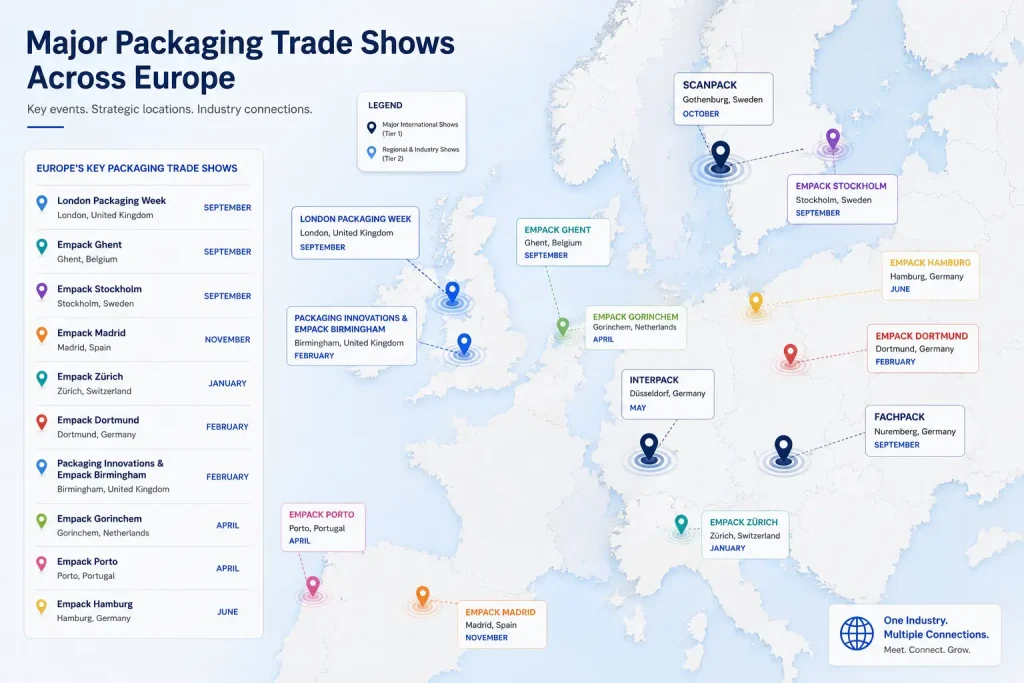
Trade shows are particularly important in the packaging industry because buyers often need to evaluate physical products, compare competing solutions, assess operational benefits, and understand how technologies fit into existing production and logistics environments.
Unlike many industries where products can be evaluated online, packaging decisions frequently involve considerations such as:
- Product protection
- Sustainability
- Operational efficiency
- Transportation costs
- Packaging speed
- Regulatory compliance
- Branding and presentation
As a result, exhibitions remain one of the most effective channels for packaging suppliers to generate leads and initiate high-value sales conversations.
Typical Visitor Types
Packaging exhibitions attract a diverse audience which means different packaging trade Show engagement strategies. the audience are:
- Packaging engineers
- Operations managers
- Plant managers
- Procurement professionals
- Supply chain directors
- Logistics managers
- Warehouse operators
- Manufacturing executives
- Product development teams
- Brand owners
- Retail packaging buyers
Major International Trade Shows
Interpack
Location: Düsseldorf, Germany
Audience:
Packaging manufacturers, machinery suppliers, food producers, pharmaceutical companies, consumer goods manufacturers, and logistics professionals.
Importance:
Interpack is widely considered the world’s leading packaging exhibition and serves as a global meeting point for packaging innovation, machinery, materials, and processing technologies.
PACK EXPO International
Location: Chicago, USA
Audience:
Manufacturing companies, packaging professionals, operations leaders, and automation decision-makers.
Importance:
One of North America’s largest packaging events, attracting buyers actively seeking new packaging solutions and production technologies.
Empack
Location: Multiple European cities
Audience:
Packaging suppliers, logistics professionals, manufacturers, and brand owners.
Importance:
Empack provides a practical and highly business-focused environment where exhibitors can connect directly with operational buyers and packaging decision-makers.
FachPack
Location: Nuremberg, Germany
Audience:
Packaging specialists, industrial manufacturers, and sustainability-focused organizations.
Importance:
Particularly strong in sustainable packaging, materials innovation, and industrial packaging solutions.
Packaging Innovations
Location: Birmingham, United Kingdom
Audience:
Brand owners, marketers, packaging designers, and packaging suppliers.
Importance:
Focuses heavily on innovation, consumer packaging, sustainability, and packaging design trends.

Industry Ecosystem
Packaging Materials
Description
Companies that manufacture the physical packaging used to contain and transport products.
Example Companies
- DS Smith
- Smurfit Kappa
- Mondi
- International Paper
Typical Products
- Corrugated boxes
- Cartons
- Paper packaging
- Flexible packaging
- Sustainable packaging materials
Typical Customers
- Manufacturers
- Consumer goods companies
- Food producers
- E-commerce businesses
- Retail brands
Choose the Right Box
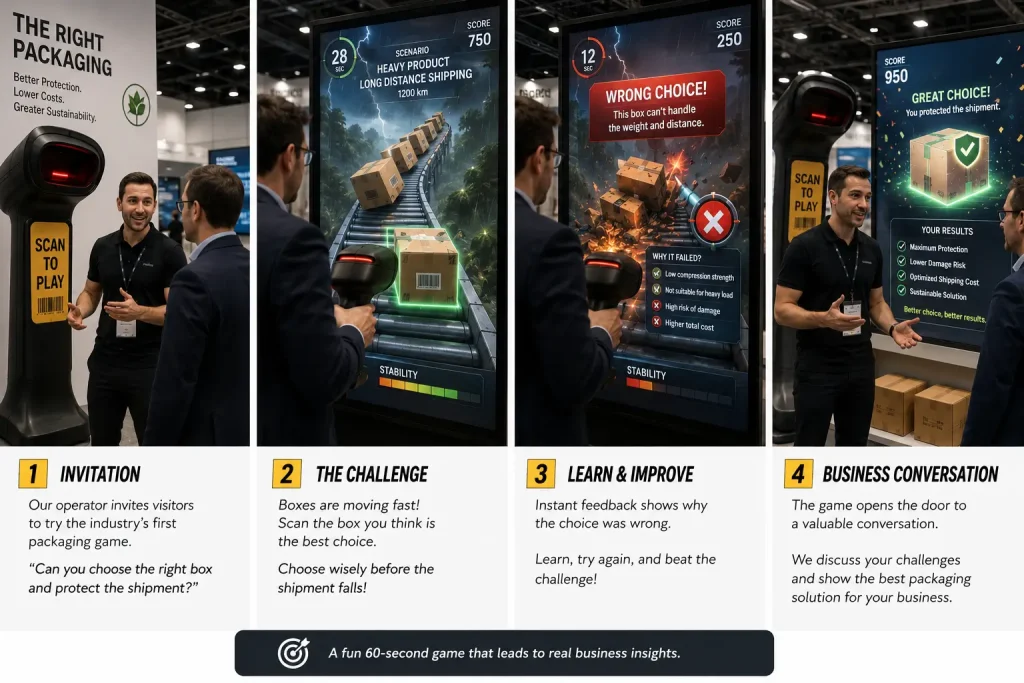
Packaging materials often look similar at first glance, making it difficult for visitors to understand why one solution may outperform another. this is our first example of packaging trade show engagement strategies.
In this interactive trade show experience, visitors are challenged to select the most suitable packaging solution for a series of real-world business scenarios. Each decision is made under time pressure, encouraging participants to think like packaging engineers, logistics managers, and supply chain professionals.
As the experience unfolds, visitors immediately see the consequences of their choices. Incorrect selections reveal potential risks such as product damage, increased shipping costs, inefficient use of space, or sustainability challenges. Successful decisions demonstrate how the right packaging choice can improve protection, reduce costs, and support operational goals.
The experience transforms complex packaging specifications into clear business outcomes, helping visitors understand the real value behind packaging design and material selection.
Most importantly, the activity creates a natural transition into meaningful sales conversations by uncovering the challenges, priorities, and decision criteria that matter most to each visitor.
Protective Packaging
Description
Solutions designed to protect products from damage during storage and transportation.
Example Companies
- Storopack
- Sealed Air
- Pregis
Typical Products
- Foam packaging
- Air pillows
- Paper cushioning
- Void-fill systems
- Dunnage solutions
Typical Customers
- E-commerce companies
- Electronics manufacturers
- Industrial suppliers
- Logistics providers
Secure the Shipment
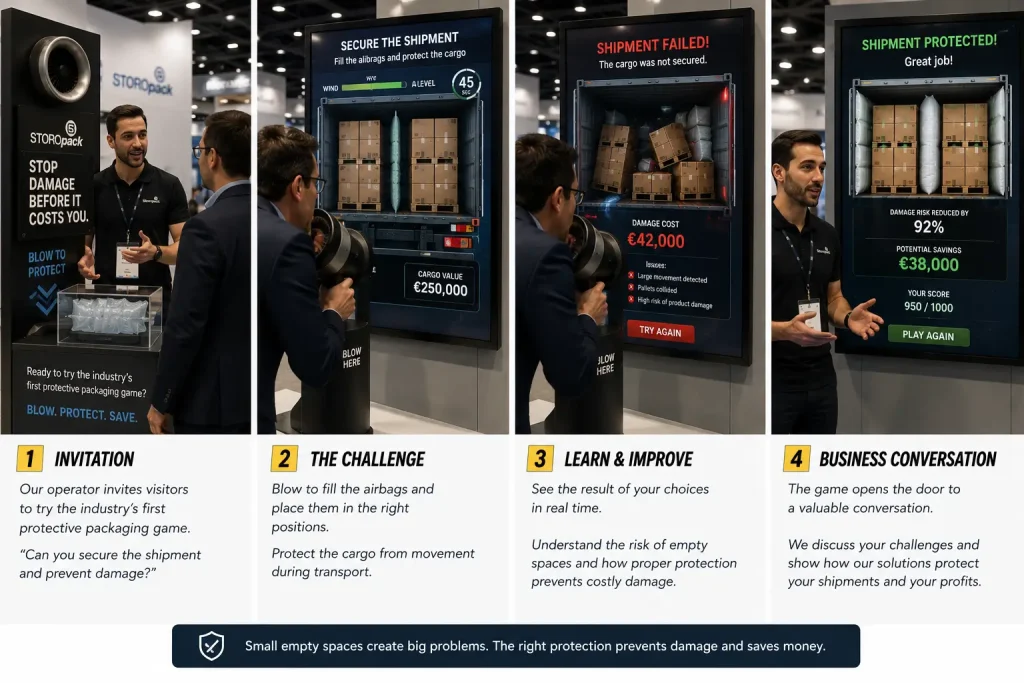
Protective packaging solutions are often overlooked because their value only becomes visible when something goes wrong.
Many logistics professionals underestimate the impact of empty spaces inside trailers, containers, and transport vehicles. Even small movements during transportation can lead to damaged products, customer complaints, replacement costs, and lost revenue.
In this interactive exhibition experience, visitors are challenged to secure a high-value shipment before transport begins. Using oversized physical controls, participants must inflate and position protective airbags to stabilize the cargo and eliminate dangerous empty spaces.
Once the shipment is prepared, the transport simulation begins. Visitors immediately see the consequences of their decisions as the cargo moves through realistic transportation conditions. Poor protection results in load movement, product damage, and financial losses, while successful protection demonstrates how proper load stabilization can dramatically reduce transportation risks.
Rather than focusing on the technical specifications of protective packaging, the experience helps visitors understand the true business impact of cargo protection. Participants discover how seemingly small packaging decisions can influence damage rates, transportation costs, customer satisfaction, and overall supply chain performance.
The experience naturally transitions into a business discussion about shipment protection challenges, transportation risks, and the potential financial benefits of implementing more effective protective packaging solutions.
Manual Packaging Tools
Description
Hand-operated tools used in packaging operations.
Example Companies
- MARTOR
- Policarpo
- Fox Solutions
Typical Products
- Safety cutters
- Tape dispensers
- Strapping tools
- Handheld coding systems
Typical Customers
- Warehouses
- Distribution centers
- Manufacturers
- Packaging service providers
Every Print Matters
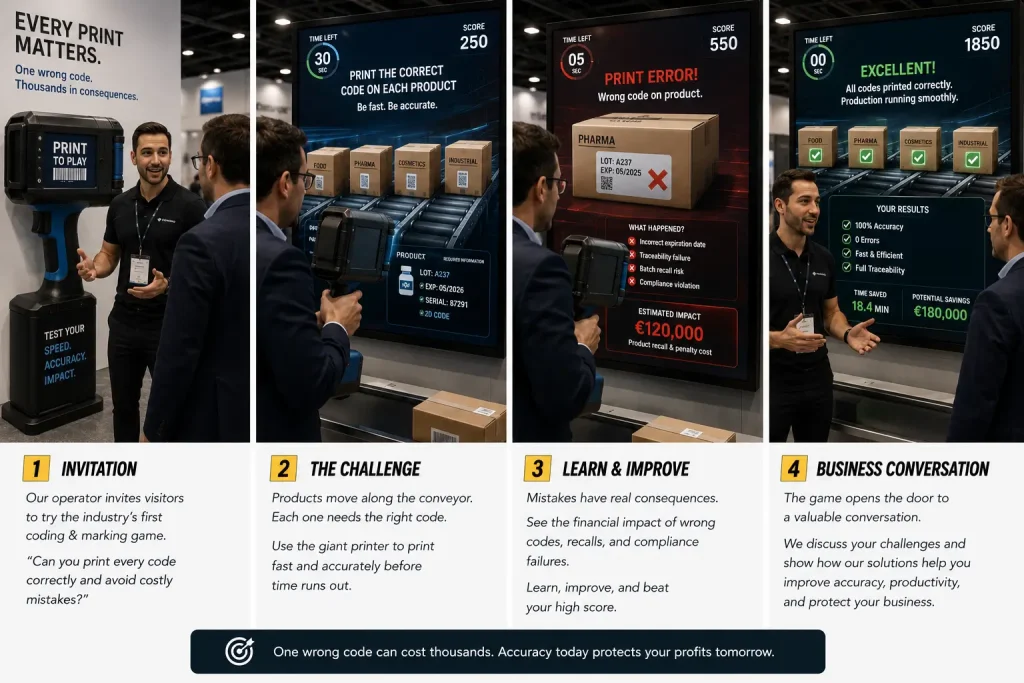
Coding and marking technologies play a critical role in modern manufacturing, logistics, and supply chain operations. While printing a code on a product may seem like a simple task, even a small error can create significant operational and financial consequences.
In this interactive exhibition experience, visitors step into the role of a production operator responsible for maintaining accuracy on a fast-moving production line. Using an oversized handheld printer, participants must quickly identify products and apply the correct codes before they move through the system.
As the challenge progresses, visitors experience the pressure of balancing speed and accuracy. Incorrect codes trigger realistic business consequences, including traceability failures, compliance risks, product recalls, and costly operational disruptions. Successful performance demonstrates how accurate coding supports efficient production, regulatory compliance, and supply chain visibility.
Rather than focusing solely on printing technology, the experience helps visitors understand the broader business impact of coding and marking systems. Participants discover how accuracy affects product traceability, operational efficiency, customer confidence, and risk management.
The activity creates a natural opportunity for deeper conversations about production challenges, quality control requirements, traceability objectives, and the financial impact of coding errors. By connecting technology performance to measurable business outcomes, exhibitors can transform a technical product demonstration into a meaningful business discussion.
Key Message: One wrong code can create thousands of dollars in downstream costs. Accurate coding protects products, profits, and brand reputation.
Packaging Equipment
Description
Machinery that automates packaging processes.
Example Companies
- Bosch Packaging
- Ishida
- ULMA Packaging
- Victor Packaging Systems
Typical Products
- Filling machines
- Sealing machines
- Wrapping systems
- Packaging lines
Typical Customers
- High-volume manufacturers
- Food producers
- Pharmaceutical companies
- Consumer goods companies
Human Speed vs. Machine Impact
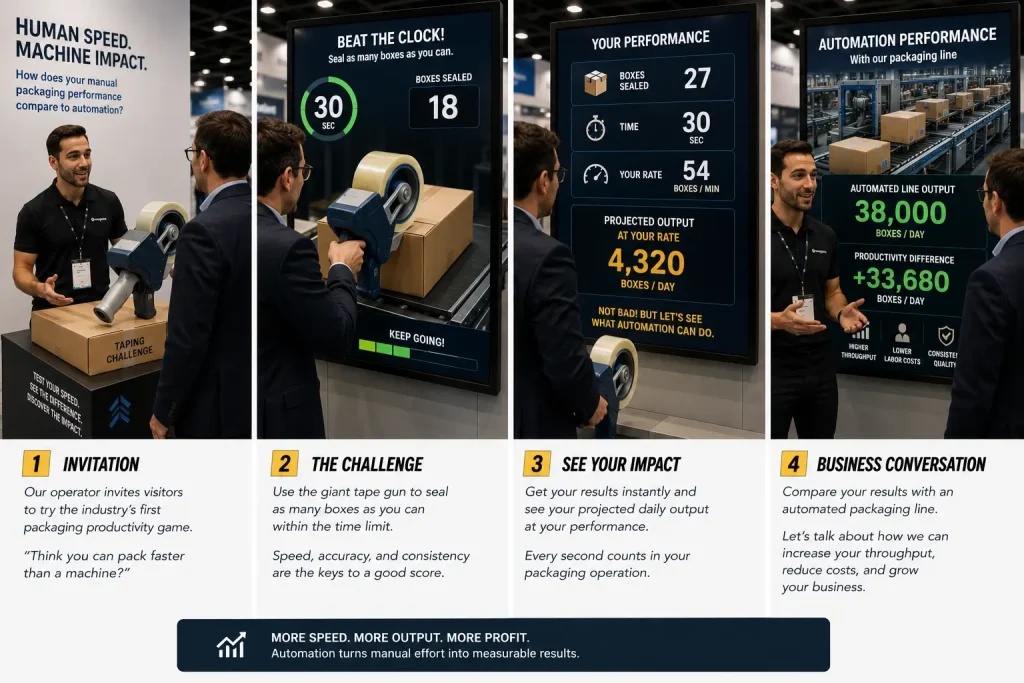
Packaging equipment manufacturers face a unique challenge at trade shows. While their machines are often impressive in size and engineering complexity, visitors frequently struggle to understand the true operational impact behind the technology.
In this interactive exhibition experience, visitors are invited to compete against the clock using an oversized packaging tool. Participants must seal as many packages as possible within a limited time, experiencing first-hand the speed, repetition, and physical effort involved in manual packaging operations.
At the end of the challenge, the system analyzes the participant’s performance and translates it into real-world operational metrics, including projected daily output and packaging capacity. Visitors can immediately see how manual performance compares to the throughput of an automated packaging line.
The experience shifts the conversation away from machine specifications and toward measurable business outcomes. Rather than focusing on motors, controls, or mechanical features, visitors gain a clearer understanding of production capacity, operational efficiency, labor utilization, and potential output improvements.
By transforming throughput and productivity into a hands-on experience, exhibitors can help visitors visualize the impact of automation on their own operations. The challenge creates a natural starting point for discussions about production bottlenecks, growth objectives, labor constraints, and return on investment.
Most importantly, the experience allows visitors to personally experience the gap between manual processes and automated performance, making the value of packaging equipment tangible, memorable, and highly relevant to their business.
Key Message: Automation is not simply about moving faster. It is about increasing throughput, removing operational bottlenecks, and creating scalable production capacity.
Coding & Marking Systems
Description
Technologies that identify, trace, and label products.
Example Companies
- Domino Printing Sciences
- Macsa ID
- Markem-Imaje
Typical Products
- Inkjet printers
- Coding systems
- Traceability solutions
- Labeling technologies
Typical Customers
- Manufacturers
- Logistics providers
- Food companies
- Pharmaceutical firms
Track It or Lose It
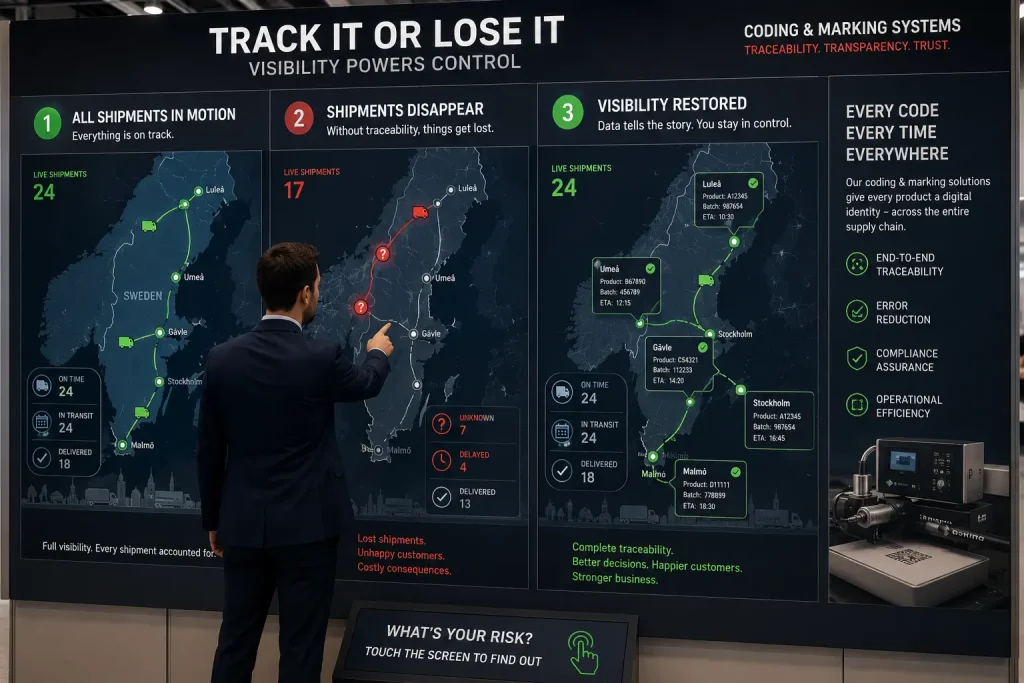
In modern supply chains, products do not simply move from one location to another. Every shipment generates data that helps manufacturers, distributors, and logistics teams monitor product movement, verify compliance, and maintain operational control.
Yet many organizations still struggle with limited visibility across their supply chains. When products cannot be accurately identified and tracked, delays become harder to investigate, recalls become more expensive to manage, and customer service teams are left searching for answers.
This interactive wall experience demonstrates the importance of product traceability through a visual journey across a live distribution network. Visitors first observe products moving smoothly through the supply chain, with every shipment visible and accounted for.
As the experience progresses, several products suddenly disappear from view. Shipment status becomes unclear, locations become unknown, and participants are faced with the operational uncertainty that many organizations experience when traceability systems are incomplete or ineffective.
In the final stage, coding and marking technologies restore visibility across the network. Detailed product information becomes instantly accessible, including batch numbers, serial numbers, shipment status, production data, and location information. Participants can immediately see how product identification enables better decision-making and faster problem resolution.
Rather than focusing on printers, labels, or marking equipment, the experience highlights the broader business value of coding and marking systems. Visitors gain a deeper understanding of how traceability improves operational control, reduces risk, supports compliance requirements, and strengthens customer confidence.
The experience naturally creates opportunities for discussions about supply chain visibility, product recalls, regulatory compliance, serialization, and traceability challenges within the visitor’s own organization.
Key Message: If you can’t track it, you can’t control it. Every product needs a digital identity throughout its journey.
Load Securing & Transport Protection
Description
Solutions that stabilize products during transportation.
Example Companies
- FROMM
- Porto Airbag
- Roliband
Typical Products
- Strapping systems
- Stretch wrapping
- Airbags
- Load stabilization systems
Typical Customers
- Logistics providers
- Manufacturers
- Exporters
- Distribution centers
The Tension Challenge
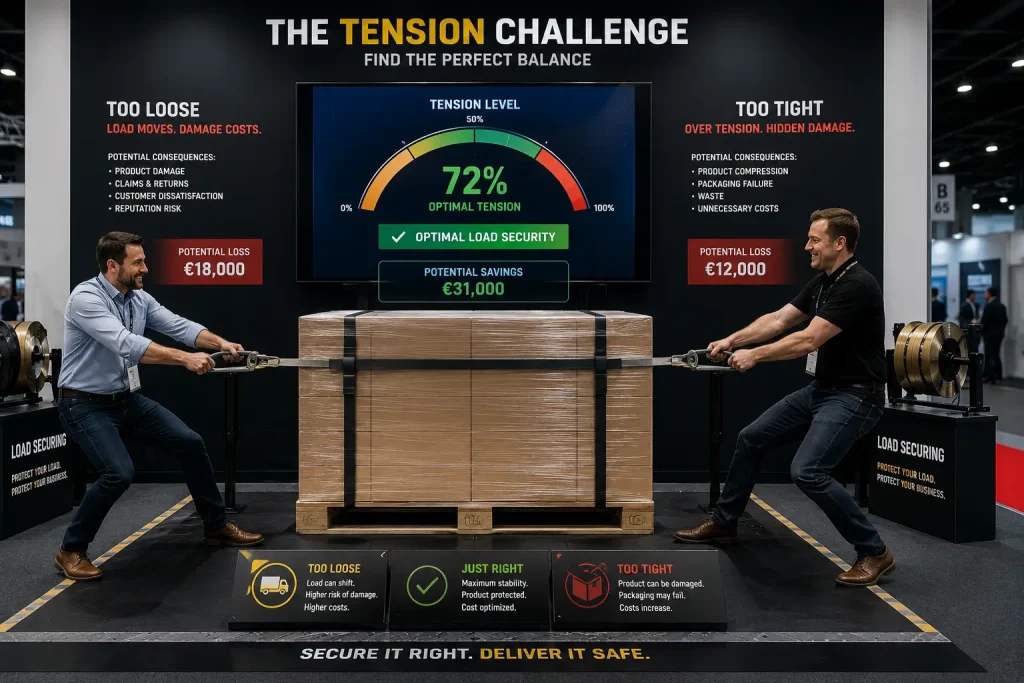
Load securing solutions are often overlooked because their value becomes visible only when a shipment is placed under real transportation stress.
Many organizations assume that securing a load is simply a matter of applying more force. In reality, both under-tensioning and over-tensioning can create costly problems. A load that is too loose may shift during transport, while excessive tension can damage products, packaging, and pallet stability.
In this interactive exhibition experience, two participants work together to secure a full pallet shipment using a large-scale strapping system. Their objective is simple: apply the correct amount of tension to achieve maximum load stability.
As tension is applied, a live monitoring system measures the force being exerted and displays the impact in real time. If the load is secured too loosely, participants see the potential consequences of cargo movement, transportation damage, product returns, and customer complaints. If the load is over-secured, the system demonstrates how excessive force can create packaging failures, product compression, and unnecessary operational costs.
The challenge encourages visitors to discover that effective load securing is not about applying the maximum amount of force. It is about achieving the optimal balance between stability, protection, and efficiency.
By transforming a technical specification into a physical experience, exhibitors can help visitors better understand the role that tension control plays in transportation safety, product protection, and supply chain performance.
The experience naturally leads to discussions about load securing practices, transportation risks, packaging standards, and the financial impact of cargo instability throughout the supply chain.
Key Message: Successful load securing is not about tighter packaging. It is about applying the right amount of tension to protect products, reduce risk, and ensure safe delivery.
Business Challenges By Category
Packaging Materials
Main Business Challenges
- Commodity pricing pressure
- Sustainability requirements
- Product differentiation
- Cost optimization
Exhibition Sales Challenges
Visitors often perceive packaging materials as interchangeable commodities.
What Visitors Struggle To Understand
- Total cost impact
- Sustainability advantages
- Supply reliability
- Performance differences
The Packaging Maze
Many packaging organizations believe their packaging process is already optimized. However, hidden inefficiencies often exist throughout the packaging and supply chain journey, creating unnecessary costs that remain invisible until they are measured.
This interactive exhibition experience transforms packaging optimization into a physical challenge. Visitors must guide a product through a large-scale maze representing a typical packaging journey, navigating a series of obstacles that reflect common business risks and operational inefficiencies.
As participants progress through the maze, they encounter challenges such as over-packaging, excessive empty space, transportation costs, material waste, product damage, and compliance risks. Each obstacle highlights a potential source of hidden cost that can impact profitability, sustainability, and supply chain performance.
The further visitors advance, the more they begin to understand how small packaging decisions can create significant downstream consequences. Even seemingly minor inefficiencies can accumulate into substantial annual costs across large-scale operations.
At the conclusion of the experience, participants receive a visual summary of the risks encountered throughout their journey and the associated business impact. The optimized path demonstrates how packaging analysis, process improvement, and expert guidance can help organizations reduce waste, improve sustainability performance, lower transportation costs, and strengthen operational efficiency.
Rather than promoting consulting services directly, the experience helps visitors discover why packaging optimization matters. It shifts the conversation from packaging components and specifications to measurable business outcomes and long-term operational improvements.
The challenge creates a natural starting point for discussions about packaging audits, cost reduction opportunities, sustainability initiatives, transportation efficiency, and supply chain optimization strategies.
Key Message: The biggest packaging costs are often the ones you cannot see. Identifying hidden inefficiencies is the first step toward improving performance, reducing waste, and unlocking measurable business value.

Opportunities For Better Trade Show Conversations
Many packaging exhibitors make the same mistake.
They focus heavily on product specifications while visitors are trying to understand business outcomes.
Most visitors do not attend exhibitions to learn:
- Material thickness
- Machine specifications
- Technical terminology
Instead, they want answers to questions such as:
- Will this reduce costs?
- Will this improve productivity?
- Will this prevent damage?
- Will this help us meet sustainability goals?
- Will this increase operational efficiency?
As a result, many booths fail to generate meaningful conversations because they present products without providing context.
Effective engagement strategies help exhibitors:
- Start higher-quality conversations
- Identify qualified buyers faster
- Educate visitors more efficiently
- Increase message retention
- Improve lead quality
- Create stronger differentiation from competitors
Most importantly, they help transform passive booth traffic into productive business discussions.
Conclusion
There is no universal engagement strategy for the packaging industry. Different exhibitors require different approaches based on their products, customers, and business objectives.
With over 10 years of experience creating exhibition games and visitor engagement experiences, we help exhibitors transform booth traffic into meaningful business conversations.
Ready to explore ideas for your next trade show?
Fill out this form and let’s talk about your exhibition goals.